The Questions You Should Ask Before Joining a Startup
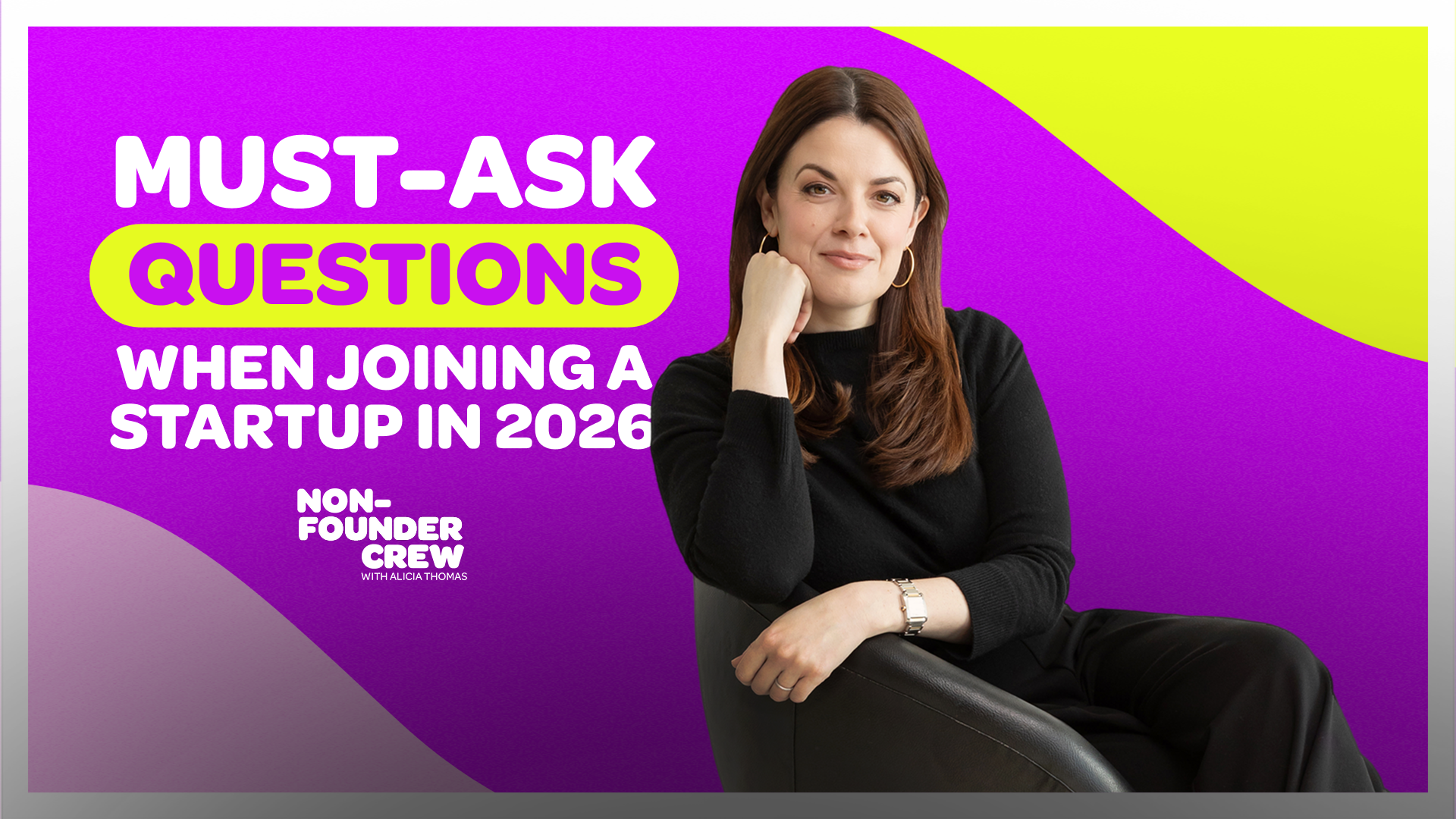
Most startup interviews are weighted in favor of the company.
The company spends weeks evaluating you. Recruiter screens, there are panel interviews, take-home projects, and reference checks.
Meanwhile, you get maybe an hour to evaluate them?
And most people waste that hour asking questions that don’t actually tell them anything important.
“What’s the culture like?”
“What do you like most about working here?”
“What are the growth opportunities?”
Meanwhile, they’re about to make one of the biggest career bets of their lives.
Tune in to the entire episode
Joining a startup is actually a bet.
You’re investing your time, your opportunity cost, and potentially your money through equity. You’re betting that the company will grow, survive, and still exist by the time your stock vests.
But most people evaluate startups based on vibes.
A hot funding round, a founder with a strong reputation, a cool product. A company people on X seem excited about.
I’ve done this too.
And I’ve also experienced what happens when you don’t dig deeper.
At one startup I joined, customers genuinely loved the team. The founders were smart. The energy was great. On the surface, everything looked promising.
But underneath that, the product wasn’t essential.
It was a “nice to have,” not something customers truly depended on. So when budgets tightened, customers cut the budget for that product first
Three months later, I was looking for another job. Not because the business failed, but because I could see the business math wasn’t adding up.
That experience changed the way I think about startup interviews completely.
The founders worth working for actually want you to ask hard questions.
One of the biggest misconceptions candidates have is that asking direct business questions somehow signals doubt or distrust. In reality, strong founders usually react the opposite way.
Good founders love hard questions
The best leaders I’ve interviewed with treated these conversations like I was already thinking like an owner. They appreciated that I wanted to understand the business deeply rather than just the perks.
The bad reactions were often more revealing than the answers themselves.
Defensiveness. Vagueness. Dodging the question. Making you feel weird for asking about runway or churn.
That tells you something important about what working there will probably feel like when things get hard.
And things always get hard in startups.
The six questions that reveal whether a startup is healthy
Most of the questions candidates should ask are not complicated. But they reveal an enormous amount about the health of a business.
Questions like:
What’s your ARR today, and what’s the target by the end of the year?
How has the company grown year over year?
What’s the current burn rate and runway?
Why do customers churn?
What’s the biggest challenge the company is facing right now?
Individually, these questions matter. But together, they tell a much bigger story.
You start understanding whether growth is realistic or fantasy. Whether the company actually understands its customers. Whether leadership is honest about weaknesses. Whether the economics of the business work at all.
One of my favorite questions is simply: “Why do customers churn?”
Because companies that deeply understand their customers almost always have a thoughtful answer ready.
They know the patterns. They know what breaks trust. They know what causes customers to leave and what they’re doing to fix it.
Weak companies tend to give vague answers because they haven’t done the work.
AI startups changed the playbook. One of the biggest points I wanted to make in this episode is that the old SaaS framework doesn’t fully work anymore, especially when evaluating AI companies.
Traditional SaaS businesses were built on software with near-zero marginal costs. Once the product was built, serving additional customers became incredibly profitable.
AI businesses are different.
Every customer interaction creates a real ongoing cost through compute and inference. And that changes the economics dramatically.
Which means some AI companies can look incredible on the surface while hiding major problems underneath.
That’s why I think candidates need to ask a completely different set of follow-up questions now:
What are your gross margins?
What percentage of revenue goes toward inference costs?
What’s your gross retention?
What’s your moat beyond the model itself?
The retention piece is especially important.
A lot of AI companies today are dealing with what some investors call the “AI tourist effect.” People try the product because they’re curious, use it briefly, then disappear.
Growth can look explosive while retention quietly collapses underneath it.
And if the company’s entire moat is “our model is better,” that’s usually not durable enough.
The equity conversation most employees don’t fully understand
Equity is another place where startup employees often make decisions with very little context.
Someone says:
“We’re offering you fifty thousand options.”
Okay. Fifty thousand of what?
The actual questions that matter are:
What percentage of the company does this represent?
What’s the strike price?
What’s the fair market value?
Are these ISOs or NSOs?
What happens if the company gets acquired?
A lot of startup employees never ask these questions because equity feels intimidating or overly technical.
But understanding your equity package can dramatically change how you evaluate an opportunity.
Especially now, when many AI companies are raising at extremely aggressive valuations.
If those companies grow into those valuations, the upside can be enormous.
If they don’t, employees can end up holding common stock that’s effectively underwater.
The takeaway
The biggest thing I hope people take away from this episode is that startup interviews should not be passive.
You are not just trying to impress the company.
You are evaluating whether this is a business worth betting years of your life on.
And honestly, the answers matter less than how leaders respond to the questions.
The best founders will walk you through the numbers. They’ll explain the tradeoffs. They’ll treat you like someone serious about understanding the business.
The wrong founders will make you feel uncomfortable for asking at all.
That difference tells you almost everything you need to know.
Oh, and one last thing! If you're a podcast person, we get into all of this and more on the latest episode of Non-Founder Crew. [link]
Tune in to the entire episode